
What is COBie?
A client-side guide to Construction Operations Building information exchange (COBie)
Overview
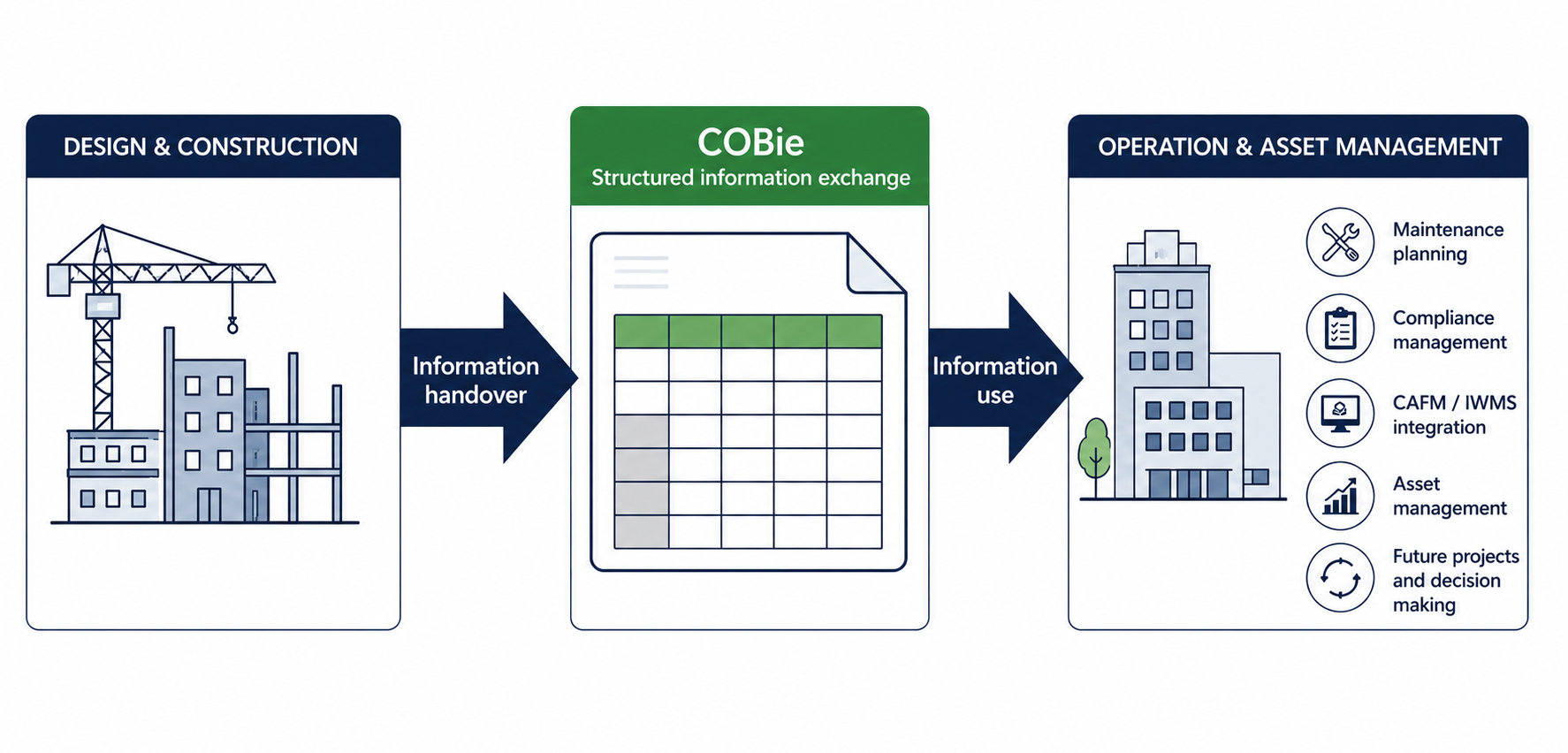
COBie — Construction Operations Building information exchange is a structured data format for transferring asset information from a construction project to the organisation that will operate and maintain the building.
Rather than delivering asset data as a collection of unstructured documents and spreadsheets, COBie provides a consistent, organised schema that allows information to be imported directly into a Computer Aided Facilities Management (CAFM) system.
COBie is widely specified on UK capital projects but widely misunderstood by the clients who ask for it.
Many estates-owning organisations include a COBie requirement in their Exchange Information Requirements without a clear understanding of what COBie should contain, what level of detail is appropriate for their needs, or how to assess whether what they receive is actually usable.
The result is COBie files that are delivered at handover, accepted without review, and then found to be incomplete or incompatible with the CAFM system they were meant to populate.
This guide explains what COBie is, how the standard has evolved, what a client should actually specify and receive, and critically, how to ensure the COBie data delivered on your project is genuinely useful to the people managing your estate.
What is COBie?
COBie stands for Construction Operations Building information exchange.
It is a non-proprietary data format most commonly delivered as a structured Microsoft Excel spreadsheet that captures the asset information generated during design and construction and organises it in a way that supports operational use.
The key distinction is that COBie is not a model. It does not capture geometry or spatial relationships. Instead, it captures the non-geometric information about a building's assets, the data that estates and FM teams actually need to manage, maintain and operate a facility: what assets exist, where they are located, who manufactured them, when they were installed, what maintenance they require, and what documentation supports them.
In plain english
COBie is a structured spreadsheet of your building's assets and the key information about each one.
It is the non-geometric answer to the question: what do I now own, and what do I need to know about it to manage it?
A well-produced COBie file should import directly into your CAFM system with minimal manual intervention.
A poorly specified or unvalidated COBie file may look complete but be unusable in practice.
The standards behind COBie
Understanding the standards that govern COBie is important for clients specifying it on projects, because the standard has evolved and the terminology around it has changed — creating confusion about what is actually required.
BS 1192-4:2014
BS 1192-4:2014 : Collaborative production of information Part 4: Fulfilling employer's information exchange requirements using COBie was the UK standard that established COBie as the preferred format for asset data exchange on BIM Level 2 projects.
Published in September 2014, it provided guidance on how COBie should be used between the client and the supply chain across the facility lifecycle.
A critical principle established in BS 1192-4 was that the client should explicitly state which COBie purposes are included and excluded for a given project. This placed the responsibility for defining the right level of COBie information firmly on the client, not the contractor.
In practice, this principle was frequently overlooked, with many clients simply requesting 'COBie at handover' without specifying what that meant in operational terms.
BS 1192-4:2014 has been withdrawn and superseded by BS EN ISO 19650-4:2022.
BS EN ISO 19650-4:2022
BS EN ISO 19650-4:2022 is the current standard governing information exchange, including COBie, within the BS EN ISO 19650 framework.
Published in 2022, it provides detailed requirements for how individual information exchanges should be structured, verified and accepted covering the roles of provider, receiver and reviewer, and the criteria against which exchanged information should be assessed.
Under BS EN ISO 19650-4, COBie remains a recognised and widely used delivery mechanism for structured asset data, but it sits within a broader framework of information exchange requirements.
Some UK-specific properties that were defined in BS 1192-4 are no longer explicitly listed in BS EN ISO 19650-4, but they can still be specified and used where they are identified in the Exchange Information Requirements reinforcing, again, that the client has both the right and the responsibility to define what COBie data is actually needed.
What does COBie contain?
COBie is organised as a series of worksheets, each capturing a different category of information about the building and its assets. The core worksheets that are most relevant to estates and FM teams are:
COBie worksheet
Facility
High-level information about the building or facility as a whole — name, description, location, and key project details.
Floor
The floor levels within the facility, providing the spatial structure into which spaces and assets are organised.
Space
Individual rooms and spaces within the building, referenced by floor, with area and classification data.
Component
Individual maintainable assets — each item of plant, equipment or building fabric element that the FM team needs to manage. This is typically the most important worksheet for operational use.
Type
Generic asset type information shared across multiple components — manufacturer, model, warranty details and maintenance intervals.
System
The systems to which assets belong — for example, heating system, fire alarm system, ventilation system.
Document
Links to operation and maintenance manuals, warranties, test certificates and other documentation associated with specific assets or types.
Contact
Details of suppliers, manufacturers and contractors associated with the assets.
Spare
Spare parts information for maintainable assets where applicable.
Resource
Materials and other resources associated with maintenance activities.
The Component worksheet is what your FM team actually needs
For most estates and FM teams, the Component worksheet is the heart of a COBie file it is the asset register.
Every maintainable asset should appear here with its location, type reference, installation date and serial number as a minimum.
A COBie file that is complete in every other worksheet but has an incomplete or inaccurate Component worksheet has failed the fundamental purpose of the exercise.
Asking for the right level of COBie information
This is the most important section of this guide for clients, and the area where most COBie specifications go wrong.
COBie can theoretically capture an enormous amount of information about every asset in a building.
In practice, requesting everything COBie is capable of containing for every asset type, at every level of detail produces a massive, unwieldy dataset that the supply chain struggles to produce accurately and that the estates team struggles to use operationally.
Equally, requesting COBie with no specification of what it should contain produces a minimal dataset that misses critical operational information.
The standard's own principle established in BS 1192-4 and carried forward under BS EN ISO 19650 is that the client must define which purposes and which asset types apply to their specific project.
The three most common COBie specification mistakes
1.Requesting COBie for everything
Applying the same level of COBie detail to every asset type, from major plant to door furniture produces an unmanageable dataset and incentivises the supply chain to populate fields with generic or placeholder data rather than accurate operational information.
Not every asset justifies the same level of data capture.
A risk-based approach, prioritising life safety systems, high-value plant and assets with significant compliance obligations, produces a smaller, more accurate and more usable dataset.
2. Not specifying which attributes are required
COBie includes many optional fields, without specifying which attributes must be populated for each asset type, the supply chain will populate what is convenient rather than what is operationally necessary.
The result is a COBie file that looks complete, all the columns are there, but is missing the specific data fields the FM team actually depends on: maintenance intervals, warranty expiry dates, serial numbers, and links to O&M documentation.
3. Not aligning COBie to the CAFM system
COBie is a delivery mechanism, not a destination and the purpose of requesting COBie is to populate a CAFM system.
If the COBie specification does not reflect the data structure, classification system and field naming conventions of the organisation's CAFM system, the file cannot be imported without significant manual translation.
The COBie specification in the EIR should be developed with direct reference to the CAFM system it is intended to populate including the exact field mapping the contractor needs to follow.
Receiving COBie is not the same as receiving usable asset data
A COBie file can be complete in structure but wrong in content populated with placeholder data, incorrect classifications, or attributes that do not match what was actually installed.
COBie must be validated against agreed acceptance criteria before handover. Checking that a file has been delivered is not the same as checking that the data it contains is accurate, complete and ready for CAFM import.
This validation step is consistently missed on projects where there is no client-side information management resource actively engaged in the process.
How COBie fits into the information requirements hierarchy
COBie does not exist in isolation. It is one delivery mechanism within a broader information management framework, and its specification should flow from the organisation's information requirements rather than being added to an EIR as a standalone requirement.
Organisational Information Requirements (OIR)
Defines the strategic information needs that ultimately determine what asset data the organisation needs to hold and use.
Asset Information Requirements (AIR)
Defines the specific asset data required operationally the attributes, classifications and formats for each asset type. The COBie specification should be derived directly from the AIR.
Exchange Information Requirements (EIR)
Specifies COBie as a required deliverable, including which worksheets must be completed, which attributes are mandatory for each asset type, and what format the data must follow for CAFM import.
The lead appointed party's plan for how COBie data will be produced, managed and delivered, including the process for populating and validating COBie during the project.
COBie file
The actual deliverable, a structured dataset that should be validated against the AIR and EIR before acceptance at handover.
Why clients ask Lynefield to support their COBie requirements
Specifying COBie correctly, at the right level of detail, aligned to the CAFM system, and with clear acceptance criteria is harder than it looks.
Most organisations find that including a COBie requirement in the EIR is straightforward, but defining what that requirement actually means in operational terms requires a combination of information management expertise and detailed knowledge of how the FM team uses asset data day to day.
Lynefield works exclusively on the client side. We help estates-owning organisations develop COBie specifications that are grounded in their Asset Information Requirements, aligned to their CAFM system, and written in a way the supply chain can actually deliver against.
We also support the validation of COBie data during project delivery and at handover, checking not just that a file has been produced, but that the data it contains is accurate, complete and ready for operational use.
If your organisation is specifying COBie for an upcoming project, has received COBie data that has not been validated, or is finding that COBie deliverables are not meeting operational needs, we would be glad to help.
Frequently Asked Questions
Is COBie mandatory on UK projects?
COBie is not mandated by legislation, but it has been the UK government's preferred schema for structured asset data exchange since 2014 and is widely specified on public sector projects, including NHS, university and local authority schemes.
Under BS EN ISO 19650, COBie remains a recognised delivery mechanism for structured asset data. Whether it is required on a specific project depends on what is specified in the Exchange Information Requirements.
What is the difference between BS 1192-4 and BS EN ISO 19650-4?
BS 1192-4:2014 was the UK standard that established COBie as the preferred format for asset data exchange on BIM Level 2 projects.
It has been withdrawn and superseded by BS EN ISO 19650-4:2022, which governs individual information exchanges including COBie, within the current BS EN ISO 19650 framework.
The core principle is unchanged: the client must define which information is required, and COBie is one of the mechanisms by which that information can be delivered.
Can COBie be delivered in formats other than Excel?
Yes. While Microsoft Excel is the most common delivery format for COBie in the UK, the data can also be delivered in other formats including IFC (Industry Foundation Classes) and XML.
COBie is essentially a subset of the data held in a BIM model, and some CAFM systems support direct IFC import rather than requiring a COBie spreadsheet.
The delivery format should be specified in the EIR and chosen based on what the organisation's CAFM system can accept.
Should we specify COBie for every asset in the building?
No, and specifying COBie for every asset type at the same level of detail is one of the most common mistakes in COBie requirements.
A proportionate approach, focused on life safety systems, high-value plant and assets with significant compliance obligations, produces a more accurate and more usable dataset than an exhaustive specification that overwhelms the supply chain and produces generic or placeholder data.
The right scope for COBie should flow from the organisation's Asset Information Requirements.
What happens if COBie data does not import into our CAFM system?
This is a common outcome when COBie has not been specified with the CAFM system's data structure in mind.
If the field names, classifications or data formats used in the COBie file do not match what the CAFM system expects, the import will fail or require significant manual correction.
The solution is to specify the CAFM import mapping in the EIR before the project begins not to attempt to reconcile the two systems at handover.
When should COBie data be first reviewed during a project?
Not at handover. COBie data should be reviewed progressively during the project, with the Component and Type worksheets checked at key information exchange points, typically aligned to RIBA stages and well before practical completion.
Issues identified mid-project are far cheaper and faster to correct than those discovered at handover, when the project team is dispersed and leverage over the supply chain is minimal.
Need help turning this into a useable document?
Lynefield helps estates and capital teams develop proportionate information requirements that suppliers can understand, price and deliver. While providing usable deliverables at handover that align with existing systems and processes.
Related Guides
The following guides from the Lynefield Knowledge Hub explore topics covered in this guide in greater depth:
• What is a Digital Twin?
• What are Organisational Information Requirements?
• What is an Asset Information Requirement?
• What is an Exchange Information Requirements document?
• What is a BIM Execution Plan?
• Why BIM handovers fail