
What is an Organisational Information Requirement (OIR)
A client-side guide to the document that should sit above every project you deliver
Overview
Organisational Information Requirements (OIR) sit at the very top of the information requirements hierarchy defined in BS EN ISO 19650. They set out the information an organisation needs, at a strategic level, to achieve its business objectives independent of any single asset, project or department.
Every other information requirement in the standard, including the Asset Information Requirements (AIR) and the Exchange Information Requirements (EIR), should ultimately be traceable back to the OIR.
In practice, the OIR is the document most estates-owning organisations have never formally written down and the one with the greatest leverage if they do. It is also, frequently, the document organisations most need external, objective support to develop, because it requires a clear view across departments, systems and strategic priorities that can be difficult to assemble from within a single function.
This guide explains what the OIR is, why it sits above everything else in the hierarchy, what a good one looks like, and how an organisation can go about establishing one.
What are Organisational Information Requirements?
The OIR defines the information an organisation needs to meet its strategic and business objectives. These objectives are rarely about buildings in isolation, they typically concern financial planning, regulatory compliance, service delivery, risk management, sustainability targets, and long-term estate strategy.
The OIR answers the question: in order to achieve these objectives, what information does the organisation need to have, hold and be able to access?
This makes the OIR fundamentally different from the AIR or the EIR, both of which are concerned with information about physical assets or specific projects. The OIR sits a level above that, it is concerned with organisational capability whether the organisation, as a whole, has the information it needs to make good decisions, demonstrate compliance, and plan effectively.
In plain english
If the AIR asks 'what do we need to know about this lift to maintain it', the OIR asks a different kind of question entirely:
what information does our organisation need, across our whole estate, to meet our statutory duties, manage our financial risk, and plan our capital programme effectively?'
The OIR comes first. Everything else including the AIR should be shaped by it, not the other way round.
Where the OIR sits in the hierarchy
BS EN ISO 19650 establishes a clear cascade of information requirements, with the OIR at the top.
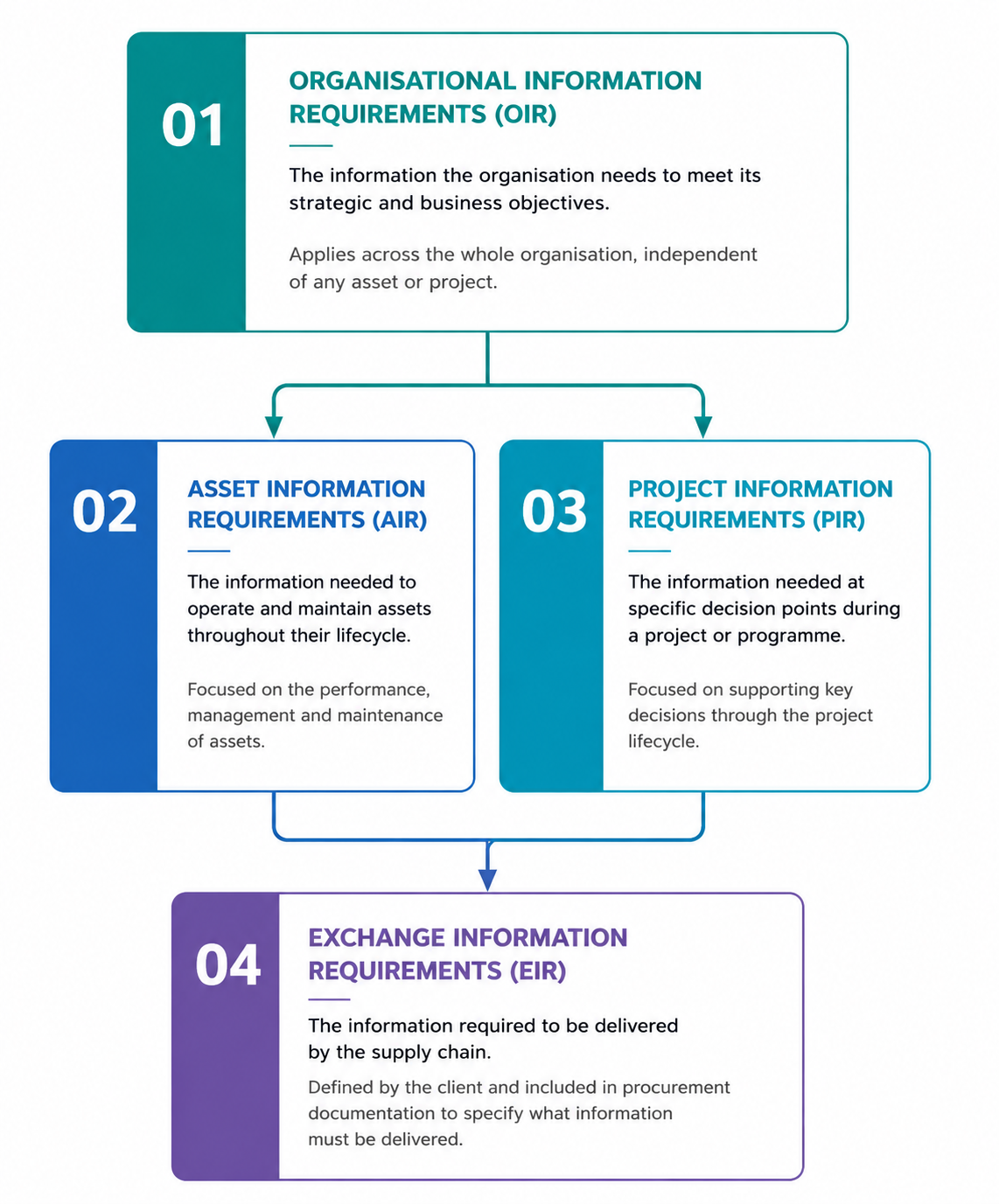
The OIR feeds both the AIR and the PIR directly. This is an important distinction from the AIR guide in this Knowledge Hub: where the AIR is specifically about operational asset data, the OIR is broader and it also shapes what information is needed at key project decision points, and informs wider organisational systems and reporting that may have nothing to do with a specific capital project at all.
In practice, very few organisations have a documented OIR. Most have, at best, an informal sense of what information matters to them held across different departments, systems and individuals, rarely written down in one place, and almost never connected explicitly to the AIRs and EIRs used on individual projects.
Why this gap matters
Without an OIR, an organisation's AIR and EIR are built on assumptions rather than evidence, assumptions about what 'good' information looks like, made without reference to the organisation's actual strategic priorities.
This is why AIRs are so often generic: they have nothing above them to derive their priorities from. An AIR built without a documented OIR behind it tends to default to industry norms rather than the organisation's specific needs.
It also means projects and operational teams can be working toward different, even contradictory, information goals without anyone realising it.
What does an OIR actually cover?
An OIR is not a BIM document, and it is not primarily a technical specification. It is closer to
a strategic information audit a structured statement of what the organisation needs to
know, and why, drawn from its actual business drivers.
A well-developed OIR typically addresses the following areas.
1. Strategic and regulatory drivers
The starting point for any OIR is the organisation's own strategic objectives and statutory
obligations. For an NHS trust, this might include estate strategy, capital planning, statutory
compliance reporting, and Building Safety Act obligations. For a university, it might include
space utilisation strategy, research facility planning, and net zero commitments. For a
housing association, it might include the golden thread requirements for higher-risk
buildings, asset management strategy, and regulatory returns to the social housing
regulator.
2. Decision-making needs
What decisions does the organisation regularly need to make, and what information do those
decisions depend on? Examples include prioritising capital investment across a portfolio,
demonstrating statutory compliance to a regulator, planning planned preventive
maintenance, or reporting on carbon performance across the estate. Each of these decisions
has an implicit information requirement behind it, the OIR makes that requirement explicit.
3. Existing systems and data landscape
An honest assessment of what information the organisation already holds, where it is held, in
what condition, and how accessible it is. This typically spans CAFM systems, asset
registers, condition survey data, compliance records, and any BIM or GIS platforms already
in use. This stage frequently surfaces fragmentation the same information held differently,
or not at all, across departments.
4. Information gaps and risk
Where the organisation's strategic and regulatory needs are not currently met by available
information, the OIR should identify the gap and the risk it creates. This is often where the
OIR delivers its most immediate value surfacing information deficiencies that carry
genuine financial, compliance or safety risk, sometimes for the first time in a documented
form.
5. Organisational responsibility for information
Who, within the organisation, is responsible for defining, maintaining and governing
information requirements going forward? Without clear ownership, even a well-developed
OIR risks becoming a one-off document that is never revisited or applied to new projects.
Why the OIR is where Lynefield adds the most value
Of all the documents in the ISO 19650 hierarchy, the OIR is the one organisations are least
equipped to develop entirely in-house, and the one external, client-side support tends to add
the most value to.
It requires a view across the whole organisation
While one department may coordinate the work, developing an effective OIR requires input from across the organisation. Estates, FM, finance, compliance, IT and clinical or academic operations (depending on sector) all hold a piece of the picture, and rarely have a shared forum for assembling it.
An independent assessment engaging each of these functions in turn surfaces a more complete and more honest picture than any single internal team is typically positioned to produce alone.
It needs to translate strategy into information terms
Most organisations can articulate their strategic objectives clearly. Far fewer have translated those objectives into a specific statement of what information is required to support them.
This translation, from strategic ambition to a structured information requirement is a specific skill, and one most internal teams have not had reason to develop, because it is not something they are asked to do often.
It benefits from independence
Departments often have an interest in how information requirements are framed, IT may favour what existing systems can already deliver, estates may favour what is operationally convenient, finance may favour what is easiest to report.
An external, client-side assessment is positioned to take a genuinely organisation-wide view, without those internal pressures shaping the outcome.
It connects strategy to what actually gets specified on projects
An OIR that is developed but never connects through to the AIR and EIR used on real
projects has limited practical value.
This is where specialist client-side support is particularly important not just producing the OIR document, but ensuring it is actually translated into the AIR and EIR requirements that shape what your supply chain is contractually required to deliver, and how that aligns with your existing systems and ways of working.
How this typically works in practice
• An OIR assessment usually starts with structured engagement across the organisation estates, FM, finance, compliance, IT and operational teams to understand strategic drivers, existing systems and current information gaps.
• This is followed by an honest assessment of how well current information practice actually supports those drivers, and where the most significant gaps and risks sit.
• The output is not just a document, but a practical foundation that directly informs the organisation's AIR, and in turn every future project's EIR so the gap analysis translates into real change on real projects, not just a report that sits on a shelf.
Developing an OIR: A practical approach
1. Engage stakeholders across the organisation, not just estates
A credible OIR requires input from finance, compliance, IT and operational leadership, not only the estates or FM function. Each will hold a different view of what information matters and why all of which the OIR needs to capture.
2. Anchor it to real strategic documents
Rather than starting from a generic industry framework, the most effective OIRs are built directly from the organisation's own strategic plans, estate strategies, regulatory obligations and board-level priorities. This ensures the resulting information requirements are genuinely tied to what the organisation has already committed to achieving.
3. Audit what already exists
An honest assessment of current systems, data quality and accessibility is essential before defining what is needed. This frequently reveals that some required information already exists but is fragmented or inaccessible, while other genuine gaps require new data capture or process change.
4. Be explicit about risk
Where information gaps create genuine exposure, compliance risk, financial risk, safety risk the OIR should say so directly. This is often what secures organisational buy-in and resourcing for the work that follows.
5. Connect it forward, not just document it
An OIR is only valuable if it actually shapes what comes next, the organisation's AIR, and from there, every EIR issued on future projects. Establishing this connection, and the governance to maintain it, is as important as developing the OIR itself.
Common mistakes with the OIR
1. Not having one at all
By far the most common situation. Most organisations move straight to project-level requirements without ever articulating what they need at an organisational level. This is rarely a deliberate choice, it is simply that no one has been tasked with producing it, and it sits outside any single department's clear remit.
2. Treating it as an IT exercise
Because the OIR concerns information, it is sometimes handed to IT to develop. IT teams understand systems well, but the OIR is fundamentally a strategic and operational document, not a technical one. It needs to be grounded in business objectives and operational reality, with IT as one contributor among several, not the primary author.
3. Confusing it with the AIR
Because both documents concern information requirements, organisations sometimes conflate the OIR with the AIR, or skip straight to the AIR without ever developing the broader organisational view. This results in an AIR that addresses asset data well but has no connection to the wider strategic and regulatory drivers it should be serving.
4. Producing it once and never revisiting it
Organisational priorities shift, new regulation, new strategic plans, new leadership. An OIR that is developed once and never reviewed gradually loses its connection to what the organisation actually needs, in the same way any strategy document does if left unrevisited.
5. Developing it without connecting it to real projects
An OIR that exists as a standalone strategic document, without a clear line through to the AIR and EIR used on actual projects, delivers limited practical value. The exercise is only worthwhile if it changes what the organisation specifies and accepts on real capital projects.
Frequently Asked Questions
What is the difference between the OIR and the AIR?
The OIR defines the information an organisation needs at a strategic level to meet its business objectives,covering decision-making, compliance, risk and planning across the whole organisation, independent of any specific asset. The AIR is narrower and more specific: it defines the operational data needed to maintain and manage built assets. The OIR should inform and shape the AIR, not the other way round.
Does a smaller organisation really need a formal OIR?
The scale of the document should be proportionate to the organisation, but the underlying exercise, understanding what information you genuinely need to meet your objectives, and where the gaps and risks are is valuable regardless of organisational size. For a smaller housing association or single-site trust, this might be a more concise exercise than for a multi-site NHS trust or university, but the principle, and the value, is the same.
Who should be involved in developing an OIR?
A credible OIR requires input from across the organisation,estates and FM, finance, compliance, IT, and operational leadership relevant to the sector, such as clinical or academic operations. Limiting development to the estates function alone tends to produce a document that reflects operational convenience rather than genuine organisational need.
How long does it take to develop an OIR?
This varies significantly by organisational complexity, but a structured assessment engaging key stakeholders, auditing existing systems, and identifying gaps and priorities typically takes a small number of weeks rather than months. The output is usually most valuable when it is focused and actionable rather than exhaustive.
How does the OIR relate to our existing CAFM and IT systems?
The OIR should take an honest account of what systems already exist and what they currently support, but it should not be constrained by them. Where existing systems cannot support the organisation's genuine information needs, the OIR should say so this is often one of the most valuable outputs of the exercise, as it gives clear, evidence based grounds for future system investment or change.
Can we develop our OIR ourselves, without external support?
It is possible, but in practice most organisations find it difficult to produce a genuinely objective, cross-departmental view from within. Internal development often reflects the priorities and blind spots of whichever department leads the exercise. A client-side assessment, run independently across departments, tends to surface a more complete picture and brings the specific experience of translating strategic objectives into structured information requirements, which is not a skill most organisations need to use
often enough to develop in-house.
What does Lynefield actually do to help develop an OIR?
Lynefield carries out a structured assessment of an organisation's current information requirements engaging stakeholders across estates, FM, finance, compliance and IT, reviewing existing systems and data, and identifying where current practice falls short of what the organisation genuinely needs from its projects and its operational systems.
The output directly informs the organisation's AIR, (which Lynefield can also assist with) and from there, the requirements specified on future projects so the assessment translates into practical change, not just a
report.
Need an OIR for your organisation?
Lynefield develops Organisational Information Requirements around your estate, CAFM and operational needs. Fixed price packages start at £3500
Related Guides
The following guides from the Lynefield Knowledge Hub explore topics covered in this guide in greater depth:
• What is a Digital Twin?
• What is an Asset Information Requirement?
• What is an Exchange Information Requirements document?
• What is a BIM Execution Plan?
• What is COBie?
• Why BIM handovers fail