
Asset Data and Handover Support
Making sure asset information is defined properly and delivered correctly
Asset data does not stop at handover. It becomes the information used to operate, maintain and keep a building compliant throughout its life. That includes planned and reactive maintenance, fire safety, safety critical assets, statutory compliance and the management of residual risk.
If it is not defined properly, checked during delivery and managed carefully at handover, the result is gaps, rework and information that does not support the estate in practice.
That is why asset data needs to be treated as a core part of BIM strategy, formalised in client information requirements and actively managed through the project from start to finish

Our approach
How Lynefield approaches asset data and handover
- Carry out a strategic review and gap analysis to understand the estate, existing systems, operational needs and current approach to asset information
- Define asset data requirements through the wider BIM strategy so the client is clear on what information matters, why it is needed and how it will support operation of the estate
- Formalise those requirements in the client information requirements so they are clear, structured and capable of being delivered through the project
- Put in place tracking, review and quality assurance measures during project delivery so asset information is checked as the project progresses
- Convert and map asset data into the client’s CAFM, CMMS, IWMS or other operational systems so it can be used properly at handover and in operation
- Support final validation, review and project handover so the asset data is complete, structured and aligned with operational needs
Key questions we help clients answer
- What asset data do we actually need for this estate
- Which assets are critical for compliance, safety and ongoing maintenance
- What information is required at handover for operation and asset management
- How should that information be structured so it can be used easily after handover
- What systems does it need to feed into
- How will we know the data is complete and good enough before we accept it
Structuring asset data properly
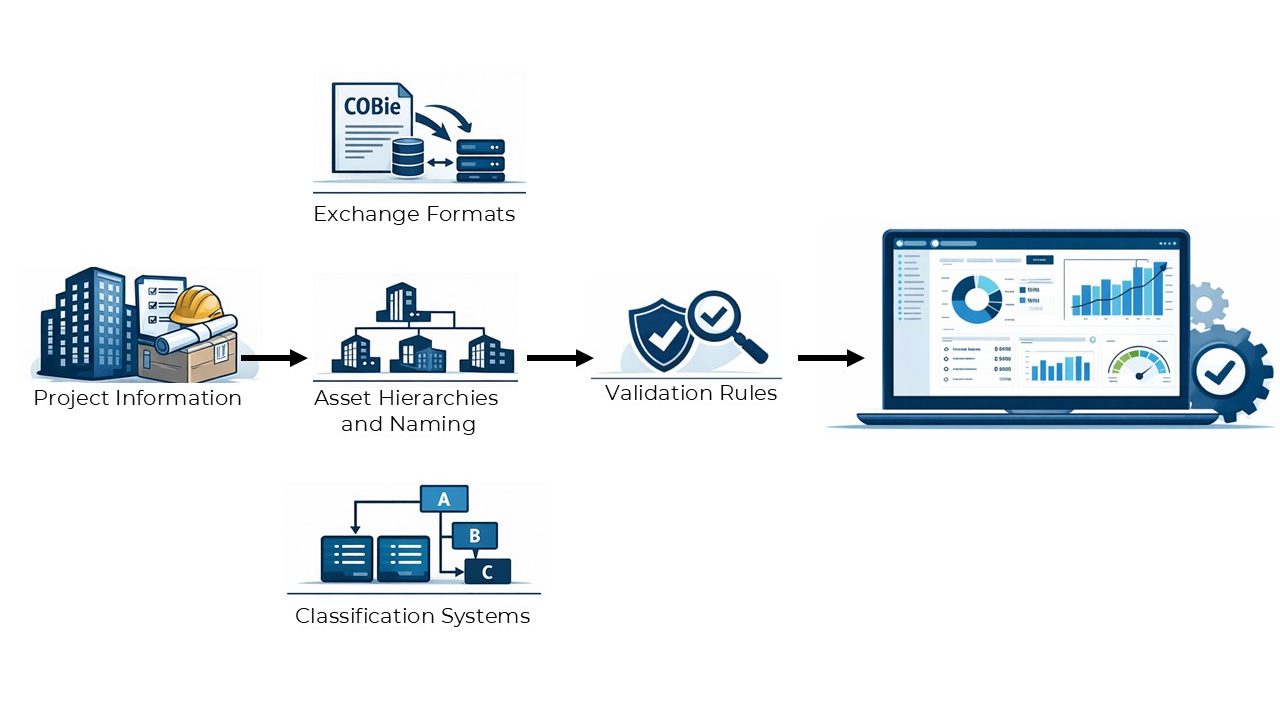
A big part of this is deciding how asset data should be structured. That may include:
- Standard exchange formats such as COBie
- Classification systems such as Uniclass or RICS NRM where appropriate
- Asset hierarchies and naming conventions
- Required parameters, attributes and data fields
- Rules for consistency, validation and acceptance
Lynefield helps clients work through those decisions in a practical way so the final approach suits the organisation, the estate and the systems that will rely on the information.
Why it matters
If asset data is not defined and managed properly, handover often becomes a rush to gather spreadsheets, fill gaps and make sense of information that was never set up to support operations in the first place. That creates risk, wastes time and reduces the long term value of the project.
Good asset data and handover support avoids that. It gives clients a clear route from strategy, to requirements, to live project controls, to operational use. The result is a more robust, reliable and secure asset information base that supports compliance, maintenance, decision making and the effective management of the estate.
Beyond Handover
Good asset information management does not stop at handover. It continues through the life of the estate. Lynefield helps organisations improve the quality, structure and usefulness of their existing asset data so it can better support compliance, maintenance, decision making and long term operational value.
- Review existing asset data sets to identify gaps, duplication, inconsistencies and opportunities for improvement
- Help clients make better use of the asset information they already hold
- Put in place clearer processes and procedures for maintaining and updating asset databases
- Improve consistency, structure and governance across existing asset information
- Support migration of asset data from legacy systems into new CAFM, CMMS or IWMS platforms
- Map and transform asset data so it is cleaner, more usable and better aligned to operational needs
- Help organisations strengthen the long term quality, reliability and value of their asset information
Talk to us
Book a meeting
Speak to one of our team now to discuss how we can help your organisation improve its BIM strategy